The Vegetable Girl Before Dawn
Acronyms: Artificial Intelligence [AI, computer systems trained to recognize patterns, generate language, make predictions, and increasingly act like decision-making clerks with better grammar and fewer tea breaks].
Very early morning has a suspicious kindness.
Not late morning. Late morning is already compromised. By then the phone has begun its insect noises, the body has remembered its unpaid bills, the tea has either been made too strong or not strong enough, and some headline somewhere has arrived like a goat through a glass door. But very early morning, the hour before the city clears its throat and begins lying professionally, still has a little softness left in it.
That is when I hear her.
A girl selling vegetables.
I have never seen her. She is somewhere a few lanes away, hidden by damp walls, sleeping dogs, half-shut shutters, and that peculiar Calcutta acoustics where a cough from one lane may arrive in another lane as political commentary. But I hear her voice. Thin. Urgent. Frayed at the edges.
She calls out the vegetables in that stretched street-seller melody which is not quite a song and not quite a cry. Brinjal, potato, greens, coriander, whatever is left from the wholesale market and from fate’s rather badly managed inventory.
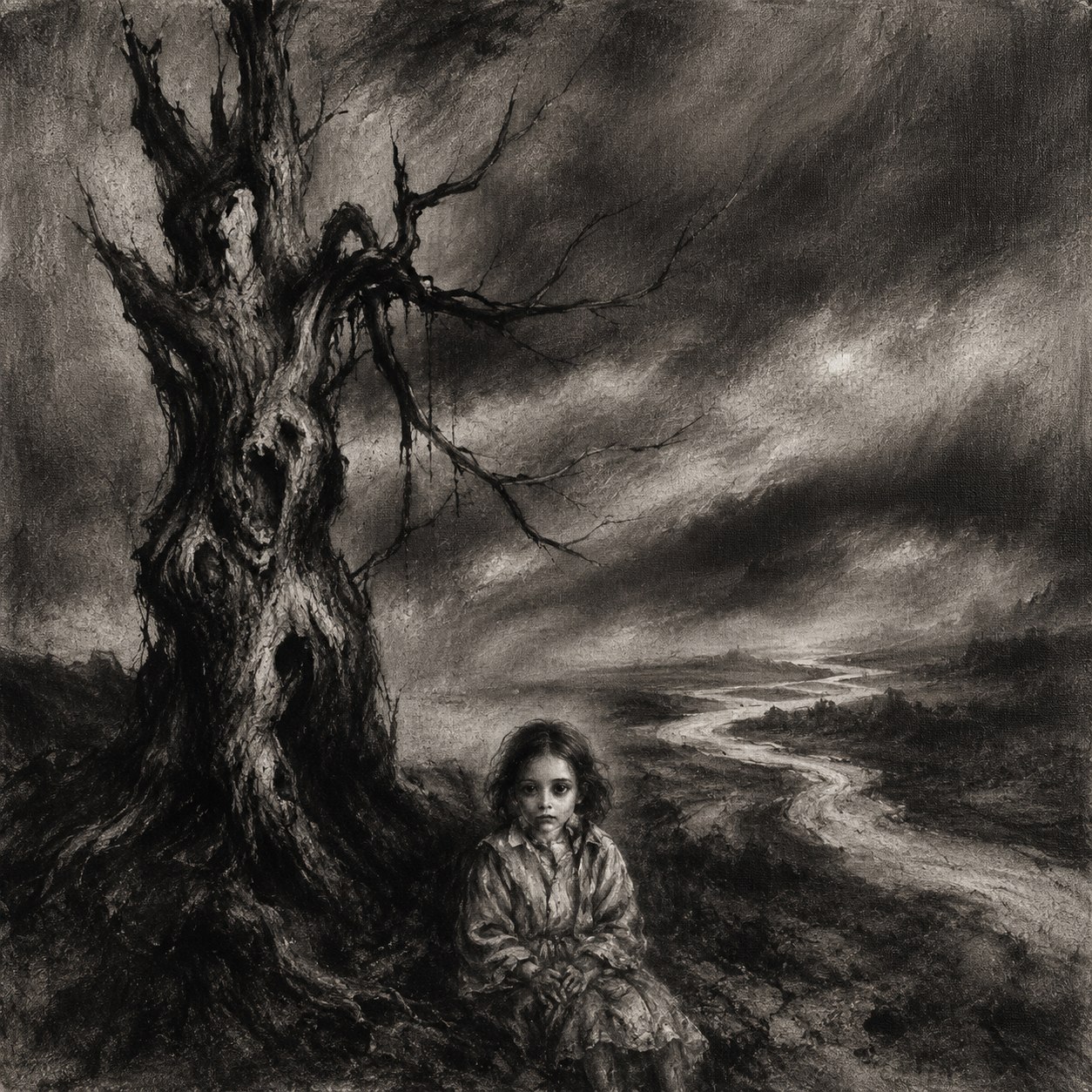
From her voice I imagine she is young.
Too young.
Oliver Twist young. The age when a child should be making a nuisance of herself over muri, mango pickle, stolen biscuits, homework, chalk dust, and small household rebellions. Not walking through lanes before sunrise with commerce sitting on her head like a sack of wet rice.
Perhaps I am wrong. Perhaps she is older. Perhaps hunger makes everyone sound twelve. Poverty has many talents. One of them is ventriloquism.
Still, in my mind I see her.
A little figure moving through a half-dystopian landscape that is not coming in the future but already parked outside, engine running. India, in its grand and tragic habit, may yet reach the negative singularity before it reaches the positive one. Not the shiny science-fiction version where AI cures disease, tutors every child, translates every language, and gives the poor a lever strong enough to move the world. No. First may come the other version. The shabby one. The one where powerful tools meet weak institutions and become, with great confidence, another way to misplace the poor.
You think technology removes cruelty.
Not quite.
Sometimes technology only gives cruelty a dashboard.
That is the small black joke of our time. A country that cannot keep drains unclogged now speaks fluently of AI. A system that can lose a pension file inside a government office for eighteen months now dreams of predictive analytics. Somewhere a consultant is making a slide with a blue gradient. Somewhere a minister is saying transformation. Somewhere a child is selling vegetables before dawn.
The future, like a tram in old Calcutta, is coming slowly, noisily, and with a conductor who may or may not return your change.
But I like these hours.
This is the contradiction. I hear that girl’s voice and feel the sadness of it. Then I look at the morning itself and feel something dangerously close to hope. Not the motivational-poster hope, that cheap plastic bucket sold near railway stations. I mean the quieter thing. The sense that the day has not yet been fully damaged.
Yesterday is gone. That is its only good quality.
Yesterday had its little humiliations. The money that did not come. The message left unanswered. The body acting like an unreliable employee. The news crawling over the world like ants over sugar. Someone somewhere shouting about borders, markets, missiles, elections, chips, data centers, climate, oil, jobs, gods, flags, and other inflammable furniture. The ordinary middle-aged man in the outer folds of Calcutta reads it all and then goes to buy eggs, because civilization may be collapsing but the omelet remains a local obligation.
And yet.
Morning opens a small door.
The next hour has not happened. The next sentence has not happened. The next cup of tea has not yet been ruined. A payment may arrive. A funny line may occur. The internet may work for seven consecutive minutes. A neighbor’s child may say something so magnificently incorrect that it rescues the day. A crow may land on a water tank with the authority of a tax inspector. A cow may block a lane and remind everyone that traffic law is merely a suggestion made by mammals with smaller horns.
Nothing is solved.
But nothing is final either.
That is the part we forget. We live inside a paper world of status, money, titles, ratings, likes, screens, shame, comparison, and other fragile nonsense dressed up as destiny. The paper world cuts deeply because paper cuts are small but vicious. You know it is thin. Still it bleeds you.
Then morning comes and, for a few minutes, peels it back.
Underneath is the older fact. The absurd fact. The fact so large that the brain cannot hold it for long without changing the subject to tea.
We are here.
That sounds simple. It is not.
To be alive at all is a statistical scandal. Every one of us is the result of a chain of accidents so long and ridiculous that if one ancestor had missed one ferry, coughed at the wrong time, eaten the wrong fish, refused one marriage, accepted another, died of fever, survived a flood, turned left instead of right, or merely looked less interesting under a mango tree, we would not exist.
Not slightly different.
Gone.
No reader. No writer. No morning irritation. No vegetable girl in my mind. No AI. No cracked phone screen. No song half-remembered from childhood. No one standing in a pharmacy counting coins and pretending not to be afraid.
Go farther back and the improbability becomes indecent. Stars had to cook the elements. Earth had to cool. Rain had to fall for ages. Life had to begin in some damp chemical mischief. Creatures had to crawl, swim, breathe, breed, flee, mutate, survive ice, fire, predators, plagues, kings, priests, landlords, bad roads, worse doctors, family expectations, and the Bengali examination system.
After all that, here we are.
Anxious primates with poetry, blood pressure, cheap plastic chairs, nuclear weapons, Rabindrasangeet, online banking, indigestion, machine learning, and the ability to feel personally insulted when a food delivery app says “arriving soon” for thirty-seven minutes.
It is magnificent.
It is also mildly comic.
An atheist has to be careful here. I do not see a divine hand arranging the tomatoes. I do not think the universe has written a personalized plan for me in invisible ink. The universe is not my career counselor. It is vast, indifferent, beautiful, violent, wasteful, and occasionally generous by accident.
But indifference does not cancel wonder.
In fact, it may deepen it. If there is no cosmic manager, then this moment is not a memo from upstairs. It is a flare in the dark. Brief. Real. Astonishing. We are not guaranteed meaning. We make it, the way a tea-seller makes tea: with heat, cheap ingredients, repetition, and a stubborn refusal to admit that the day is lost.
That is why the girl’s voice matters.
Not because suffering is noble. It is not. Suffering is mostly boring, grinding, repetitive, and badly paid. Do not let poets and politicians overdecorate it. A child should not have to become a street vendor before the sun has finished yawning. A society that lets children sound tired before breakfast has failed in some plain and practical way. No philosophy should be used as perfume over that smell.
But the voice still matters because it interrupts the fake world.
It says: look here.
Not at the market. Not at the minister. Not at the billionaire promising to reinvent human life from an air-conditioned room. Not at the influencer holding a cup of coffee as if she has discovered agriculture.
Here.
In the lane.
At the edge of hearing.
A child, or someone sounding like a child, selling vegetables into the gray morning.
And then the strange thing happens. Her voice, instead of only depressing me, opens the whole day. It makes the world less abstract. Poverty becomes not a policy word but a throat. AI becomes not a grand future but a question: who will be helped, who will be sorted, who will be ignored, who will be made legible only when someone wants to deny them something? Luck becomes not a greeting-card word but a terrifying arithmetic. Life becomes not a motivational slogan but a narrow bridge, and we are all crossing it with bags in both hands.
Maybe that is all awareness is.
Not peace. Peace is difficult. Peace requires either wisdom, money, excellent digestion, or a rare defect in the imagination.
Awareness is smaller.
It is the ability to catch yourself before the paper world swallows you whole. Before you believe that your bank balance is your soul. Before you believe that other people’s shiny lives are evidence against your own. Before you forget that every ordinary morning is sitting on top of billions of years of unlikely accidents like a clay cup balanced on a pyramid.
This does not pay the rent.
I know.
Cosmic luck is not legal tender. Try telling the pharmacist that your existence is astronomically improbable and see how many tablets he gives you. Try telling the landlord that stars exploded so your carbon could become a tenant. He may admire the science and still ask for the money.
Reality remains.
The body remains. The bills remain. The fear remains. The loneliness of a 51-year-old single man in the far edges of Calcutta remains, with its fan noise, sweating walls, unstable income, medicines to buy, tabs open on the laptop, old American memories arriving like postcards from a country that has misplaced your forwarding address.
But the morning gives one discount.
For a little while, it reduces the volume of falseness.
The vegetable girl calls. The city stirs. Someone pumps water. Someone quarrels softly. A pressure cooker begins its first warning. A scooter coughs like a retired uncle. The sky changes color with no interest in our opinions. The day comes in barefoot.
And I sit there, not healed, not improved, not transformed into one of those suspiciously cheerful people who drink green juice and speak of abundance.
Only reminded.
That we are lucky beyond comprehension.
That the world is unjust beyond excuse.
That both things are true.
That imagination is not an escape from reality but sometimes the only lantern we have inside it.
And that if we could remember, even for five minutes a day, how unlikely it is to be here at all, perhaps the artificial world would hurt a little less. Not vanish. Not become harmless. Just lose some of its authority.
The girl’s voice fades down the lane.
The day begins.
The miracle, being poorly managed as usual, continues.